
Best Cat Scratching Post Materials for Real Cats

Your sofa is not evidence that your cat is being difficult, spiteful, or “bad.” It is evidence that the sofa may currently offer something your cat needs: a satisfying texture, a stable surface, a good stretch, or a location that feels socially important. Choosing the best cat scratching post materials can make a meaningful difference, but material is only one part of helping your cat scratch where everyone can live comfortably.
Scratching is normal feline behavior. Cats scratch to maintain their claws, stretch their bodies, leave visual marks, and deposit scent from glands in their paws. It can also be a way to regulate emotion. A cat who scratches near a doorway after a noisy delivery, for example, may be responding to a change in their environment. Behavior is information, and a thoughtful scratching setup helps us meet cats where they are rather than trying to punish a natural need.
The Best Cat Scratching Post Materials Depend on Preference
There is no single material every cat will love. Some cats want a coarse, shreddable surface; others prefer a firm woven fabric or a flat cardboard pad under their paws. The best choice is the one your individual cat uses comfortably and repeatedly.
If your cat has already chosen the arm of an upholstered chair, look closely at what they are telling you. They may prefer a vertical surface, a fabric-like texture, and a spot near where the family spends time. Buying a small horizontal scratcher in a quiet back room may not compete, even if it is marketed as premium.
Sisal fabric: a reliable choice for many cats
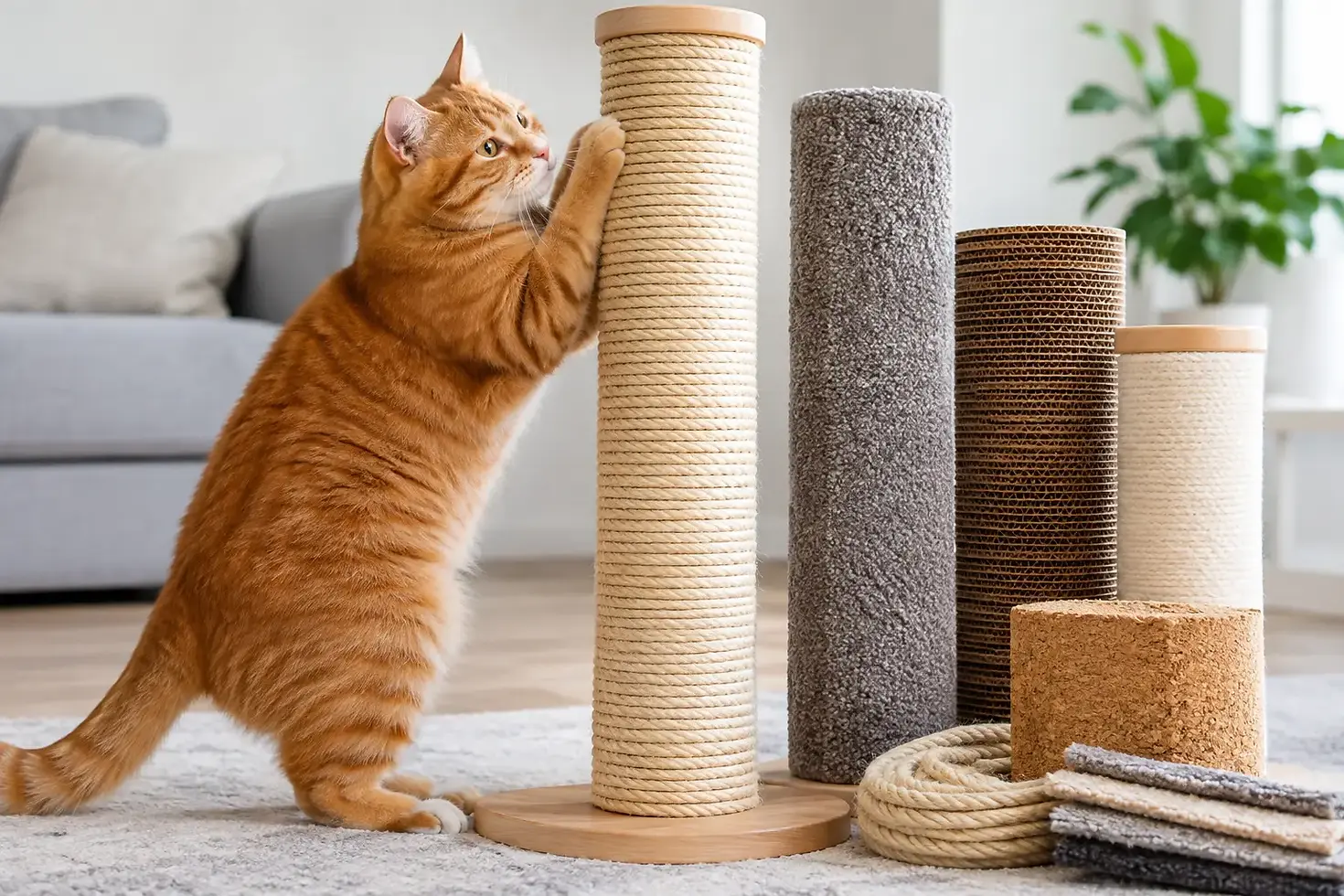
Sisal fabric is often one of the strongest all-around options. It has a rough, natural texture that gives many cats satisfying resistance, and high-quality sisal fabric tends to hold up well through repeated scratching. It is especially useful on tall vertical posts and cat trees because it creates a broad, stable scratching area.
Look for tightly woven sisal with no loose edges your cat can pull away. The fabric should be securely attached, without exposed staples or adhesive where paws and claws can reach. A post covered in sisal fabric is often a good first choice for a cat who likes to stretch upward while scratching.
Sisal rope: useful, with a few cautions
Sisal rope is common and can be appealing to cats who enjoy a deeply textured surface. It is generally affordable and easy to find, but quality matters. Rope can loosen or fray over time, creating gaps that catch claws or unravel into strands a curious cat may chew.
Choose a post with rope wrapped tightly and evenly from bottom to top. Once the rope becomes loose, worn, or heavily frayed, replace or repair the post rather than waiting for it to become a snagging hazard. For households with cats who chew string-like items, a flat sisal fabric surface may be the safer starting point.
Cardboard: low-cost, highly satisfying, and temporary
Corrugated cardboard scratchers are not a lesser option. Many cats genuinely prefer them, especially for horizontal scratching. The layered edges provide a shreddable texture that can feel very rewarding under the claws, and the slight give of cardboard suits cats who do not enjoy hard surfaces.
Cardboard does wear out quickly and leaves bits around the floor, which can be frustrating in a busy home. Still, its low cost makes it a useful way to test your cat’s preferences. Try one flat cardboard scratcher and one angled option before assuming your cat only likes the couch. Replace cardboard when it is flattened, damp, heavily soiled, or coming apart in large pieces.
Carpet: sometimes familiar, often confusing
Carpet-covered posts were once everywhere, but they are not the best fit for every home. A cat who likes carpet may use one enthusiastically. The drawback is that a carpet post can feel too similar to the household rug, stair runner, or bedroom carpet. For some cats, it does not clearly communicate which surface is theirs.
If your cat is scratching carpet, a carpeted scratcher placed directly over or beside that spot can be a helpful short-term management tool. Over time, you may be able to offer a different texture nearby and gradually make the preferred option more convenient. Avoid very loose-looped carpet, which can snag claws.
Natural fibers and wood: good options for some households
Seagrass, jute, and tightly woven natural-fiber mats can offer a pleasant alternative for cats who like rough horizontal surfaces. Because these materials vary widely in construction, inspect them regularly for loose fibers, sharp backing, or unraveling edges. They are often better as mats or boards than as very tall posts.
Some cats enjoy unfinished wood surfaces, particularly sturdy wooden boards or cat furniture with a textured grain. Wood should be smooth enough to prevent splinters and free from strong finishes, paints, or chemical odors. It is usually best used as part of a larger scratching station rather than as the only option.
Material Matters, but Stability Matters More
A beautiful scratching post that tips, wobbles, or slides can teach a cat to avoid it. Cats need to feel secure enough to fully stretch and pull against the surface. If the post moves when your cat uses it, the couch may remain the safer, more reliable choice.
For vertical scratchers, aim for a post that is taller than your cat’s full-body stretch. Many adult cats do well with a post around 30 to 32 inches tall, though bigger cats may need more height. It should have a wide, heavy base or be securely mounted so it does not sway.
Horizontal and angled scratchers should also stay put. A lightweight cardboard pad can be placed in a non-slip holder or against a wall. If your cat likes to scratch while leaning into the surface, an angled board may be more successful than a flat pad.
Offer a Small Menu, Not One “Perfect” Post
In most homes, one scratching surface is not enough. Cats often scratch in different places for different reasons. A tall sisal post near the living room may support stretching and scent marking in a shared social space, while a cardboard scratcher near a window can become part of a relaxed observation routine.
Offer more than one texture and orientation at first. A practical setup might include a tall sisal-covered post, a horizontal cardboard scratcher, and an angled or wall-mounted option. This is not spoiling your cat. It is providing appropriate outlets for a normal behavior, much like offering a litter box in a location your cat can comfortably access.
Location is just as important as the material. Place scratchers near current scratching spots, near sleeping areas, and at entrances to rooms your cat uses often. Cats commonly scratch after waking, so a scratcher beside a favorite nap spot can be especially effective.
Help Your Cat Choose the New Surface
When you add a new scratcher, make it easy for your cat to discover it. You can sprinkle a little catnip or silvervine on an appropriate surface if your cat enjoys those scents, or place a favorite toy nearby. Some cats respond well when you gently drag a wand toy up the post, inviting them to reach and stretch.
Reward your cat calmly when they use the scratcher. A small treat, soft praise, or a brief play session can help build a positive association. Do not force your cat’s paws onto the post, scold them for scratching furniture, or use startling deterrents. Those responses can create stress without teaching a clear alternative. Your cat does not need to be scared to learn.
While your cat is developing a new habit, protect the furniture they have targeted. Temporary furniture covers, double-sided tape designed for pet-safe use, or moving a scratcher directly beside the favorite corner can reduce rehearsal of the old behavior. Once the new option is consistently chosen, you can gradually adjust its position if needed.
When Scratching Changes Suddenly
A sudden increase in scratching, intense claw biting, or a new reluctance to use familiar surfaces can be worth a closer look. Pain, changes in mobility, household stress, conflict with another pet, or changes to the home environment may all influence behavior. If your cat seems uncomfortable, has damaged claws, or shows other changes in appetite, litter box use, or social behavior, start with your veterinarian.
For ongoing furniture scratching, multi-cat tension, or a cat who seems stressed despite plenty of scratching options, individualized support can help uncover the emotional and environmental pieces. You are not failing, and your cat is not giving you a hard time. They may be having a hard time.
At Purrfect Paws University, we help guardians create practical, Fear Free plans without fear, force, or judgment. If you would like calm, personalized support for scratching or other behavior concerns, schedule a free phone consultation and let’s find an option that helps your cat feel at home.


Comments